
Sensorial development
Giving order to what the senses perceive
Montessori Sensorial materials help children isolate qualities, discriminate differences, grade, classify, sequence and build precise language for perception.
01 / Direct answer
What is Sensorial learning in Montessori?
Sensorial learning is a Montessori curriculum area that helps children refine and organise sensory perception. Materials isolate qualities such as dimension, colour, form, texture, weight and sound so children can compare, grade, classify and name differences with increasing precision.
02 / Understand the principle
01
The senses already receive information; Sensorial work organises it
Young children constantly experience colour, shape, size, texture, sound and weight. Sensorial materials do not “switch on” the senses. They create clear comparisons that help the child notice relationships inside information already being received.
A tower that changes systematically in three dimensions or a set of colour tablets that can be graded makes an abstract relationship visible and manipulable.
02
Isolation of difficulty
Many Sensorial materials vary one important quality while keeping other features relatively consistent. If the purpose is to compare length, distracting differences are reduced. If the purpose is colour, shape and size are controlled.
This design helps the child direct attention toward the exact relationship being studied.
03
Control of error
A well-designed material often gives the child information about whether the arrangement works. A cylinder may not fit its remaining socket; a graded construction may look visibly irregular.
The adult does not need to announce every mistake. The child can inspect the result, revise and repeat, changing error from judgement into information.
04
From perception to language
Once the child has handled and compared a quality, the guide can attach exact vocabulary: thick and thin, rough and smooth, loud and soft, sphere and cube, darker and lighter.
Language becomes more meaningful because the words refer to distinctions the child has physically experienced.
05
Indirect preparation for later abstraction
Sensorial grading and classification prepare habits of mind used later in mathematics, geometry, science and language: noticing attributes, ordering sets, comparing relationships and forming categories.
This preparation is indirect because the child is not doing a disguised worksheet. They are refining perception in its own right while building structures that later learning can use.
03 / In the classroom
Recognisable Sensorial experiences
A few classic materials illustrate the design logic without reducing Sensorial education to a catalogue.
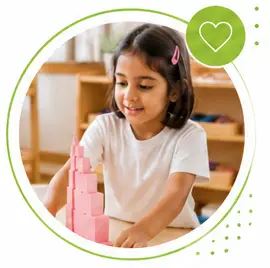
Pink Tower
Ten cubes vary systematically in three dimensions. Building from largest to smallest makes visual grading and precise movement part of one coherent task.
Brown Stair
Prisms vary in thickness while length remains constant, helping the child isolate and compare dimension.
Colour tablets
Children match and later grade colours, refining visual discrimination and vocabulary.
Sound cylinders
Paired containers are matched by sound, directing attention to auditory discrimination without visual clues.
04 / Developmental significance
What Sensorial work develops
Discrimination
Children learn to detect finer differences rather than treating sensory experience as undifferentiated.
Classification
Objects can be grouped and ordered according to specific attributes, a foundation for logical thought.
Vocabulary
Exact words are attached to exact perceptual relationships.
Precision and attention
Materials reward careful comparison and repeated self-correction rather than speed.
05 / Common misunderstandings
What this principle does—and does not—mean
Misunderstanding
Sensorial materials are sensory toys.
In practice
They are sequenced educational materials designed to isolate qualities, refine discrimination and support classification, language and later abstraction.
Misunderstanding
The brighter and more stimulating the classroom, the better the sensory development.
In practice
Montessori often uses visual restraint so the relevant quality of a material can stand out clearly.
At The Freethinking School
How this appears across our Montessori programs
Toddler environments contain simpler experiences of matching, sorting, texture, form and movement suited to the younger child.
The Primary Program introduces formal Sensorial sequences and vocabulary that later connect naturally with mathematics, geometry, language and cultural classification.
07 / Parent questions
Frequently asked questions
01What is the purpose of Montessori Sensorial materials?+
They help children isolate, compare, grade, classify and name sensory qualities with increasing precision.
02What does isolation of difficulty mean?+
It means a material is designed so one important quality changes while other features remain controlled, helping the child focus attention on that relationship.
03What is control of error in Montessori?+
It is feedback built into a material or activity that allows children to notice and correct mistakes with less dependence on adult judgement.
04How does Sensorial work prepare for mathematics?+
Grading, sequencing, comparison, dimension and classification build perceptual and logical habits that later support number, geometry and measurement.
05Does Sensorial learning include sound and touch?+
Yes. Montessori Sensorial work can address visual qualities, touch, sound, weight, temperature and smell where developmentally appropriate.
06Why are Montessori Sensorial materials so precise?+
Precision ensures the intended quality is clear enough for meaningful comparison and self-correction.