
Montessori and traditional education
Different ways of organising the learning environment
A respectful comparison of how Montessori and more conventional classrooms may differ in pacing, adult role, movement, assessment, motivation and responsibility.
01 / Direct answer
How is Montessori different from traditional education?
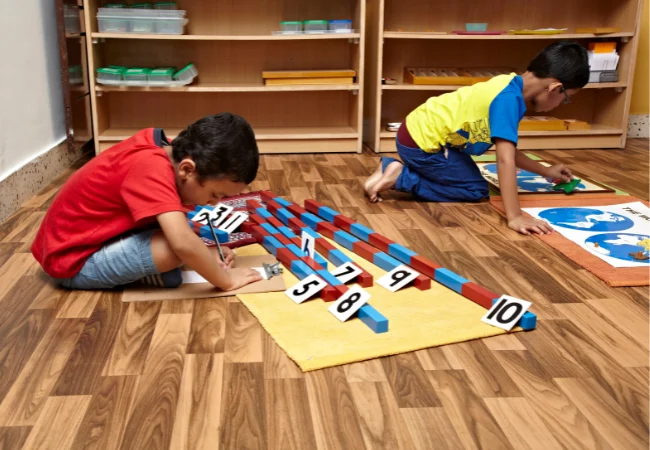
Montessori typically organises learning around individual and small-group presentations, mixed-age communities, hands-on sequenced materials, extended work cycles and substantial child choice within limits. Conventional classrooms more often use same-age groups, common pacing, teacher-led lessons and scheduled subject periods. Both can be implemented with varying quality.
02 / Understand the principle
01
Pacing: individual sequence vs common timetable
Montessori guides introduce work according to readiness and track progression individually. This allows one child to repeat foundational work while another advances, without treating either pace as a classroom disruption.
Traditional settings often gain efficiency by moving a same-age group through a shared sequence. This can provide common reference points and coordinated assessment, but it may offer less room for extended repetition during the school day.
02
The role of the adult
Montessori educators often present briefly and then withdraw so the child can practise. In more conventional instruction, the teacher may remain the central source of explanation, pacing and feedback for a larger portion of the lesson.
Neither means the adult is more or less caring. The difference is where the educational system places responsibility during the learning process.
03
Movement and materials
Montessori integrates movement into learning: children fetch, carry, build, sort, trace, arrange and restore. Many concepts are first encountered through manipulable material before moving toward symbols and abstraction.
Traditional classrooms may use manipulatives too, but written, verbal and digital representations often become central earlier.
04
Error correction and assessment
Many Montessori materials include a control of error that helps children notice a mismatch without immediately seeking adult judgement. Guides also observe work and maintain records rather than relying only on visible tests or grades in early childhood.
Conventional systems may use more frequent teacher-marked tasks, group benchmarks and formal assessments. These can provide standardised information but create a different relationship with error.
05
Motivation and classroom responsibility
Montessori tries to make satisfaction in mastery, contribution and increased capability primary motivators. Rewards can exist in wider life, but the classroom is designed so work itself has meaning.
Responsibility is also concrete: choosing work, completing sequences, caring for materials and restoring the environment are part of the educational day rather than separate behaviour systems.
03 / In the classroom
A side-by-side view
These are tendencies rather than universal rules. Individual schools may differ significantly.
Lesson structure
Montessori: individual or small-group presentation followed by independent repetition. Traditional: whole-group or subject-group lesson followed by common practice.
Age grouping
Montessori: developmental multi-year grouping. Traditional: usually same-age class grouping.
Work period
Montessori: longer uninterrupted blocks with varied individual work. Traditional: more frequent subject transitions and time-defined periods.
Correction
Montessori: material-based control of error, observation and re-presentation. Traditional: more direct teacher feedback, marking and formal assessment.
04 / Developmental significance
The question behind the comparison
What is the child practising?
Look beyond labels and ask whether the daily structure gives children meaningful practice in attention, reasoning, independence and social responsibility.
How is challenge matched?
Ask how the environment responds when a child needs more repetition—or is ready to move further.
What happens after an error?
The classroom’s response to error strongly shapes whether children experience mistakes as information or primarily as judgement.
Who carries responsibility?
Notice how much of the day is organised by adults and how much children learn to organise for themselves.
05 / Common misunderstandings
What this principle does—and does not—mean
Misunderstanding
Montessori has no academics.
In practice
Montessori contains extensive sequences in language, mathematics, culture and science, usually introduced through concrete and progressively abstract work.
Misunderstanding
Traditional schools are always rigid and Montessori schools are always flexible.
In practice
Implementation varies. The more useful comparison is how a specific classroom handles pacing, choice, feedback, movement and responsibility.
At The Freethinking School
How this appears across our Montessori programs
TFS Toddler and Primary environments use Montessori principles such as prepared spaces, choice within limits, practical responsibility, individual presentation and uninterrupted work periods.
For families anticipating a later move to another system, the relevant preparation is not only academic content but the child’s ability to listen, organise work, persist, ask for help and increasingly learn without continuous adult prompting.
07 / Parent questions
Frequently asked questions
01Is Montessori academically rigorous?+
Montessori includes systematic language, mathematics and cultural curricula. Rigour comes through sequence, precision, repetition and increasing abstraction rather than through early dependence on worksheets or grades.
02Does Montessori prepare children for traditional school?+
It can. Transition depends on the child and receiving school, but Montessori intentionally develops academic foundations alongside independence, concentration, organisation and comfort with purposeful work.
03Does Montessori use tests?+
Early childhood Montessori relies heavily on observation, work records and material-based feedback. Formal assessment practices vary by school and age level.
04Are Montessori children free to avoid difficult subjects?+
No. Choice operates within a curriculum. Guides observe patterns, make presentations and redirect children so development remains balanced.
05Is Montessori better for every child?+
No educational model can be assumed to be universally best. Families should consider the quality of implementation, the child, the educators and the learning environment as a whole.
06Why does Montessori have longer work cycles?+
Longer uninterrupted periods allow children to choose, settle, repeat, recover from distraction and reach deeper concentration without frequent schedule-driven transitions.