
Culture and science
Helping the child locate themselves in a connected world
Montessori culture brings geography, biology, botany, zoology, science, history, art and music into one widening field of inquiry.
01 / Direct answer
What is Culture in Montessori education?
Montessori Culture is the curriculum area through which children explore the wider human and natural world. Geography, biology, botany, zoology, science, history, art and music are connected through observation, classification, stories, hands-on work and real experiences.
02 / Understand the principle
01
From the immediate world outward
Young children first know the world through direct contact: water, soil, leaves, animals, weather, food, family, language and place. Montessori cultural work gives names and relationships to these experiences, then extends beyond what the child can directly see.
A puzzle map, classified card set or botanical specimen is valuable when it becomes a doorway into further questions, not an isolated fact to memorise.
02
Classification creates intellectual order
Children compare land and water forms, parts of plants, kinds of animals or features of continents. Classification helps them recognise both similarity and difference.
This builds a habit essential to science: look closely, identify attributes, group carefully, revise categories when new information appears.
03
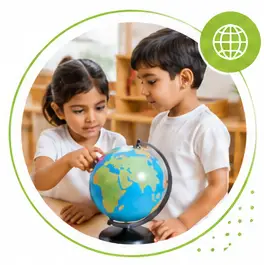
Geography answers “Where am I?”
Work can move from land and water, globe and map, to continents, countries, people and ways of living. Good cultural education avoids turning people into costumes or stereotypes; it presents human communities with respect and context.
The goal is orientation: the child begins to locate home inside a much larger world.
04
Biology and earth science answer “What is around me?”
Plants, animals, habitats, weather, seasons and the structure of the earth invite sustained observation. Children learn names, parts, functions and relationships.
Whenever possible, direct encounters—gardening, observing a leaf, noticing cloud changes, caring for living things—give the vocabulary something real to attach to.
05
Culture should lead beyond the shelf
Montessori materials organise foundational knowledge, but the wider purpose is curiosity. A child who learns the parts of a flower should become more capable of seeing the next real flower, not merely more capable of completing a matching card.
This is where Montessori cultural work connects strongly with experiential and enrichment learning: classification inside the classroom expands into exploration outside it.
03 / In the classroom
Questions that organise cultural learning
The curriculum becomes coherent when facts answer larger human questions.
Where am I?
Globes, maps and land/water forms help children move from immediate place toward a wider geographic frame.
What is living around me?
Botany and zoology work develops observation, naming, classification and respect for living systems.
How does the physical world behave?
Simple scientific investigations invite prediction, observation and explanation grounded in direct phenomena.
How do people create and live?
Art, music, stories, history and cultural study widen the child’s understanding of human expression and community.
04 / Developmental significance
Why cultural work matters
Curiosity
Well-chosen facts become anchors for further questions rather than endpoints.
Classification
Children practise organising complex information according to meaningful attributes.
Language
Scientific and cultural vocabulary expands the child’s ability to describe the world precisely.
Perspective
The child begins to understand that their immediate environment is part of larger ecological and human systems.
05 / Common misunderstandings
What this principle does—and does not—mean
Misunderstanding
Montessori Culture is an “extra” after language and maths.
In practice
It is a core area that builds scientific observation, vocabulary, classification, geographical orientation and connection to the wider world.
Misunderstanding
Culture means teaching children isolated facts about countries.
In practice
The stronger aim is interconnected understanding—place, living systems, physical processes, history, art and human communities.
At The Freethinking School
How this appears across our Montessori programs
Toddler cultural learning begins with the immediate environment: names of real objects, nature, songs, food, people and everyday phenomena.
Primary children can move into formal geography, botany, zoology and science sequences, with TFS enrichment and experiential learning providing opportunities to encounter those ideas beyond the classroom.
07 / Parent questions
Frequently asked questions
01What subjects are included in Montessori Culture?+
Common areas include geography, biology, botany, zoology, earth and physical science, history, art, music and studies of people and cultures.
02Why is classification important in Montessori science?+
Classification teaches children to notice attributes, compare, organise information and build more precise concepts about the natural world.
03Does Montessori teach geography in preschool?+
Yes, in developmentally appropriate forms such as land and water, globes, maps, continents, cultural vocabulary and connections to real places.
04How does Montessori teach science?+
Through observation, precise vocabulary, classification, demonstrations, hands-on investigation and connections to real natural phenomena.
05How does cultural work connect with enrichment?+
Classroom concepts become richer when children encounter nature, art, music, community and scientific phenomena through wider experiences.
06Is Montessori cultural education fact-based or inquiry-based?+
It includes accurate foundational knowledge but uses that knowledge to support observation, connection-making and further inquiry.