
The prepared environment
A classroom designed so the child can act
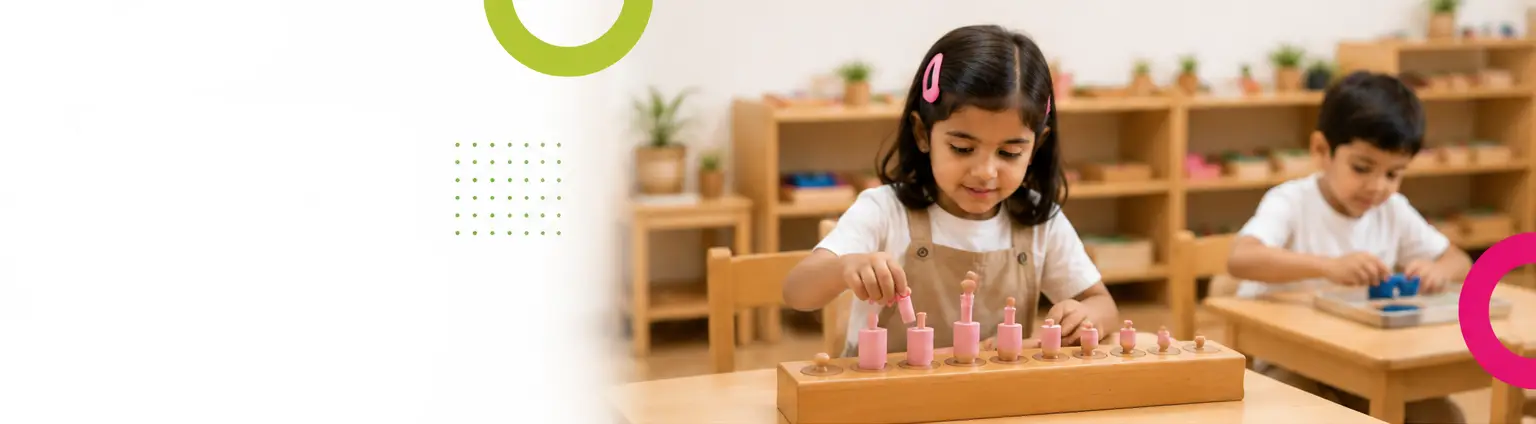
In Montessori, the environment is intentionally prepared to reduce unnecessary dependence on adults and make purposeful activity accessible.
01 / Direct answer
What is a Montessori prepared environment?
A prepared environment is a carefully ordered space designed around the developmental needs, proportions and independence of the child. Furniture, materials, movement pathways, routines and limits are arranged so children can increasingly choose, use and restore work without constant adult assistance.
02 / Understand the principle
01
The environment acts as an indirect teacher
A well-prepared classroom answers many questions before a child needs to ask them. Where does this belong? Can I carry it? What comes next? How many are available? Where may I work? The arrangement itself supplies information.
This reduces verbal management. Instead of adults repeatedly saying “put that back”, “wait”, “ask me”, or “do not touch”, the room is built to make appropriate action clearer.
02
Order, beauty and simplicity are functional
Montessori order is not decoration. A stable place for each material helps the child orient, remember sequences and act independently. Beauty matters because care invites care; simplicity matters because excessive visual and material stimulation can make purposeful choice harder.
A Montessori shelf is selective rather than crowded. Materials are chosen because they answer a developmental purpose, not because more options automatically mean richer learning.
03
Accessibility changes the adult–child relationship
Child-sized furniture, low shelves, reachable water, usable cleaning tools and manageable containers allow the child to participate directly. The adult no longer needs to mediate every small action.
This has a subtle consequence: the child receives repeated evidence that the environment expects competence. A two-handed tray, a small jug or a cloth within reach says, in effect, “you can learn to handle this.”
04
Limited quantities create real social conditions
Many Montessori materials appear only once in a classroom. This protects the integrity of the sequence and creates natural opportunities to wait, observe, choose something else and recognise that a shared community has limits.
The guide does not need to manufacture every lesson in patience. The structure of the environment provides it.
05
Movement is designed into learning
Children carry work to tables or mats, walk to shelves, fetch materials, pour, sort, grade, build and restore. Movement is not treated as a break from cognition. For the young child, purposeful movement is often part of how thought becomes organised.
03 / In the classroom
What parents can notice in a well-prepared environment
Look beyond the presence of Montessori materials and notice how the room supports behaviour.
Clear pathways
Children can move between shelves, tables and floor mats without repeatedly crossing through other children’s work.
A visible sequence
Materials progress from simpler to more complex forms, allowing the guide to introduce new challenges without turning the room into a display of disconnected activities.
Tools that actually work
A child-sized broom is still functional. A small jug still pours. Reduced scale is useful only when the object allows genuine participation.
Restoration is part of the work
Completing an activity includes returning each piece and placing the material back where another child can find it ready.
04 / Developmental significance
Development supported by design
Orientation and memory
Consistent locations and sequences reduce cognitive noise and help children remember what to do next.
Coordination
Carrying, unrolling, pouring and navigating around others refine purposeful movement.
Self-regulation
A calm, legible environment makes it easier to choose, persist and recover from distraction.
Responsibility
The child experiences care of the classroom as participation in community life, not merely as obedience to an adult.
05 / Common misunderstandings
What this principle does—and does not—mean
Misunderstanding
A Montessori classroom is Montessori because it contains wooden materials.
In practice
Materials are only one part. Access, order, movement, adult behaviour, work cycles, limits and the developmental sequence determine whether the environment functions in a Montessori way.
Misunderstanding
A calm classroom must be restrictive.
In practice
Calm can emerge from purposeful engagement and clear organisation. Children still move, speak, collaborate and make choices.
At The Freethinking School
How this appears across our Montessori programs
Toddler environments are especially attentive to scale, movement, language and care-of-self routines because dependence can often be reduced by redesigning the environment.
Primary environments expand the academic sequences while preserving the same logic of access, order, choice, restoration and increasing responsibility.
07 / Parent questions
Frequently asked questions
01Why is Montessori furniture child-sized?+
It allows children to sit, move, carry and organise their work with less adult assistance, making independence physically possible.
02Why are Montessori materials kept on open shelves?+
Open shelves make appropriate choices visible and accessible while also making the order and sequence of the environment clear.
03Why is there often only one of each Montessori material?+
Limited quantities protect the material sequence and create natural opportunities for waiting, observing and choosing alternatives.
04Why do Montessori classrooms look less cluttered?+
The environment is intentionally edited so children can orient and choose purposefully without unnecessary visual and material overload.
05Do children have to put their work back?+
Yes. Restoring materials is part of completing the activity and part of responsibility toward the next person who may use it.
06Can a Montessori prepared environment be created at home?+
Elements can be used at home—accessible storage, child-sized tools, predictable places and real participation—but a home does not need to imitate a full classroom.